
From 30 June to 3 July 2026, the French Institute of Bioinformatics (IFB/ELIXIR-FR) travelled to Strasbourg for the latest edition of JOBIM, the major annual gathering of the French-speaking bioinformatics community. It was a packed and highly engaging four days of talks, posters, demonstrations and networking, organised by teams from all over France.
Four days of diverse presentations
From day one, the IFB/ELIXIR-FR stand was set up at the entrance to the conference, alongside those of JeBIF (Young Bioinformaticians of France) and the SFBI (French Society for Bioinformatics). The organisation of this Strasbourg edition relied in part on the involvement of our local IFB/ELIXIR-FR colleagues, Valérie Cognat (JOBIM 2026 organising committee), Kamel-Soaid Ferrahi, Julien Seiler and Elora Vigo, who served as volunteers throughout the event.
This first half-day also featured a demonstration of the madbot tool, presented by the #madbotByIFB team, before giving way to the traditional opening drinks reception.
The second day began with the session ‘Knowledge Graphs and Biomedical Data Integration’, chaired by Jacques van Helden, Deputy Director of IFB/ELIXIR-FR, for the three presentations. In the early afternoon, just before the SFBI’s Annual General Meeting, the Director of IFB/ELIXIR-FR, Morgane Thomas-Chollier, chaired the keynote presentation delivered by IFB/ELIXIR-FR: Christophe Dessimoz (Swiss Institute of Bioinformatics SIB/ELIXIR-CH), who gave a presentation on open biological databases as a strategic infrastructure. The afternoon provided an opportunity for the management of IFB/ELIXIR-FR to present our infrastructure, our missions and services during the ‘Bioinformatics Networks’ session, alongside the SFBI, the GDR BIMMM, the MERIT network and JeBIF.
On the third day, IFB/ELIXIR-FR organised and hosted the mini-symposium ‘Orchestrating data flows throughout their lifecycle’. Among the three other mini-symposia running in parallel, IFB also co-organised the mini-symposia ‘Is the structural annotation of genes in eukaryotic genomes still a challenge? ’ alongside the CNRS MERIT network and the INRAE PEPI IBIS network, and ‘International Bioinformatics Connection: Spotlighting Sequencing’ alongside the SFBI, the IRD, WAVE, AB3C, the LNCC and Joseph Ki-Zerb University.
Our teams then presented their posters. In the early afternoon, we attended Sarah Cohen-Boulakia’s keynote speech on reproducibility in bioinformatics, with Hélène Chiapello, co-head of the IFB/ELIXIR-FR Training Team, acting as chair.
Finally, on Friday, two new demonstrations took place simultaneously, alongside the final poster session, before the Strasbourg event drew to a close with closing remarks and words of thanks from the organising team and the SFBI.
The mini-symposium ‘Orchestrating data flows throughout their lifecycle’
Organised by Thomas Denecker and Jacques van Helden, with contributions from Frédéric de Lamotte, Alban Gaignard, Jean-François Dufayard, Nadia Goué and Hamid Ouahioune, this mini-symposium highlighted that the orchestration of data flows – from the collection of metadata to the assessment of their ‘FAIRness’, including their processing and submission – is a key challenge for all research projects. The session provided an opportunity to take stock of existing and emerging resources available to meet the needs of the health and biology communities.
Following an original introduction on the blackboard by Jacques van Helden (after a minor technical fault with the video projector), the presentations followed one after the other, tracing the data lifecycle. Among the presentations were: Sylvain Milanesi on data management plans and the project lifecycle checklist; Valentin Loux, drawing on the experience of the Migale platform (an IFB member platform), on managing data flows across multiple projects; Thomas Denecker and Julien Seiler on data deposit requirements in France and the future development of madbot; as well as feedback from Laurent Jourdren following their use of madbot within the GenomiqueENS platform; and finally a presentation by Brieuc Quemeneur on FAIRChecker, a tool for measuring the FAIRness of data.
Three IFB/ELIXIR-FR demonstrations
- madbot – madbot, an online metadata and data brokering tool designed to ensure the adoption of standards and FAIR principles in an open science context
Presented by Imane Messak, Baptiste Rousseau and Elora Vigo, madbot is a tool developed by IFB/ELIXIR-FR-core to automate the organisation, description and submission of scientific data to repositories such as Zenodo or ENA, in accordance with international standards – a streamlined process for more open and accessible data.
- ViromeChat-AI – ViromeChat-AI: a conversational interface for exploring viral metagenomic data in the Virome@tlas project
Presented by Romuald Marin, this demonstration highlighted the conversational interface of the Virome@tlas project, which centralises global data on viruses, their hosts and their ecosystems. Based on a large language model (LLM) combined with a RAG approach and backed by a Neo4j database, it enables users to ask complex questions about ecology, health or biogeography in natural language, without the need for expertise in bioinformatics and whilst minimising the risk of hallucinations.
- Biosphere – Open access to adaptable computing resources within repeatable environments
Presented by Matis Zouari, this demonstration provided an insight into the Biosphere portal, which offers a catalogue of pre-installed cloud environments (RStudio, Jupyter, workflows, etc.) for reproducible analyses that can be adapted to different user profiles, without the need for in-depth technical expertise, via an architecture connected to eight partner clouds.
13 posters presented by IFB-core
- Interoperability – Structuring and Interoperability of Thematic Data Management Plans for Research Entities – Sylvain Milanesi, Saliha Zenboudji-Beddek, Jean-François Dufayard, Christophe Bruley
Developed by IFB/ELIXIR-FR in collaboration with the INBS club, a structured Data Management Plan (DMP) model is used to describe the practices of research platforms. Combined with the DSW@IFB tool and a Python interface, it enables the automatic transfer of DMPs to DMP-OPIDoR, thereby enhancing interoperability between tools.
- ABRomics – cgMLST typing on the ABRomics web platform – Julie Lao, Raphaël Tackx, Amanda Dieuaide, Thomas Mignon, Cléa Siguret, Hugo Lefeuvre, Alix De Thoisy, Bérénice Batut, Nadia Goue, Sébastien Leclercq, Etienne Ruppe, Sylvain Brisse, Philippe Glaser, Claudine Medigue and Fabien Mareuil
The ABRomics platform automatically analyses sequencing data (FASTQ/FASTA) to detect resistance genes, virulence factors, plasmid types and bacterial species. Its cgMLST typing, based on CoreProfiler and BIGSdb-Pasteur, enables One Health surveillance by cross-referencing clinical, veterinary and environmental data.
- ABRomics – Retrieval-Augmented Generation over Genomic Reports in the ABRomics Platform – Raphaël Tackx, Julie Lao, Amanda Dieuaide, Thomas Mignon, Cléa Siguret, Hugo Lefeuvre, Alix De Thoisy, Bérénice Batut, Nadia Goue, Sébastien Leclercq, Etienne Ruppe, Sylvain Brisse, Philippe Glaser, Claudine Medigue and Fabien Mareuil
ABRomics now incorporates a retrieval-augmented generation (RAG) system to analyse and contextualise resistance data, via four modules: query triage, RAG on segments of structured reports, RAG based on a resistance ontology, and text-to-SQL translation.
- ABRomics – PanGBank: a Database of Pangenome Graphs for Comparative Microbial Genomics – Jean Mainguy, Téo Lemane, Claudine Médigue, Alexandra Calteau, David Vallenet
PanGBank, a database dedicated to the exploration of microbial pangenomes, brings together more than 4,000 prokaryotic pangenomes (at least 15 genomes per species), constructed using PPanGGOLiN via a reproducible Nextflow pipeline, and accessible via a REST API and a web interface designed for researchers who are not developers.
- Open Science: A Catalogue of European Tools Supporting Research Data Management – Saliha Zenboudji-Beddek, Jean-François Dufayard, Sylvain Milanesi, Christophe Bruley, Anne-Françoise Adam-Blondon
Developed by ELIXIR Europe with active input from IFB/ELIXIR-FR, RDMkit is an online guide organised by country, professional role or scientific field, designed to help apply the FAIR principles throughout the data lifecycle; it includes, in particular, the Data Stewardship Handbook and the RDM Maturity Model.
- RDMkit efficiently manages metabarcoding and metagenomic data – Clara Emery, Erwan Corre
Led by the ELIXIR Biodiversity and Microbiome communities, a new RDMkit page dedicated to metabarcoding addresses the need to standardise data management in this field, drawing on the combined expertise of the Biodiversity, Microbiome, Plants, Nutrition and Interoperability communities.
- ATLASea – BYTE-Sea: the digital infrastructure of ATLASea, the French marine genome sequencing programme – Annie Lebreton, BYTE-Sea consortium, Erwan Corre
Over the course of three years, the ATLASea programme has collected more than 7,000 samples (2,000 species, 26 phyla) and assembled 220 genomes. The BYTE-Sea portal, coordinated by the IFB/ELIXIR-FR, centralises these data, ensuring their interoperability, security and dissemination in accordance with the FAIR principles.
- ATLASea – BYTE-Sea: Navigating IT Systems and Web Portals for Sample Tracking and Marine Data Exploitation – Loraine Brillet-Guéguen, Annie Lebreton, Wael Ben Ammar, Lucile Jeusset, Yaelle Pihan, BYTE-Sea consortium, Erwan Corre
To ensure the dissemination and accessibility of data from the ATLASea programme, BYTE-Sea has developed an infrastructure based on three complementary portals: a Tracker Portal for real-time monitoring, a public, open-access Data Portal, and a Marine Genomics Portal – currently under development – for advanced genomic analysis.
- madbot – A national working group promoting the development, adoption, and dissemination of madbot – Imane Messak, Baptiste Rousseau, Elora Vigo, Madbot Working Group, Hélène Chiapello, Nadia Goué, Julien Seiler, Thomas Denecker
Ce poster présente le groupe de travail national réuni autour de madbot, dont l’objectif est de favoriser le développement, l’adoption et la diffusion de l’outil pour la gestion FAIR des données et métadonnées, dans une dynamique communautaire et collaborative.
- IFB – Biosphère Cloud, Multi-Cloud Infrastructure for Life Sciences – Christophe Blanchet, Matis Zouari, admins des sites Cloud
Given the wide variety of bioinformatics tools available, Biosphere offers a catalogue of pre-installed environments for reproducible analyses, accessible via the cloud without the need for advanced technical expertise, within a scalable architecture connected to eight partner cloud providers.
- Cloud4SAMS: a trusted research environment to handle human gut microbiome data – Nicolas Pons, Guillaume Gautreau, Aïcha El Jai, Claudine Médigue, Cloud4SAMS consortium et al.
As part of the PEPR SAMS programme (2024–2028), Cloud4SAMS is rolling out a secure, distributed infrastructure to analyse human microbiome data – more than 100,000 metagenomes made publicly available since 2010 – whilst protecting the personal and medical information that this data may reveal.
- Cloud4SAMS – Balancing Open Science and Data Privacy: The Challenge of Human Microbiome Research – Guillaume Gautreau, Brieuc Quemeneur, Alexandrina Bodrug et al.
This second Cloud4SAMS poster sets out the architecture implemented to balance data openness and data protection: a federated resource catalogue based on the IFB/ELIXIR-FR and ELIXIR standards, differentiated secure environments (Biosphere for non-sensitive data, Arcana for sensitive data, HDS-certified), and an access and authorisation management module.
- MetaPanG: a pangenome graph-based method for strain-level profiling of prokaryotic microbiomes – Téo Lemane, Jean Mainguy, Claudine Médigue, Alexandra Calteau, David Vallenet
MetaPanG uses the PanGBank pangenome collections to identify and quantify microbial strains in metagenomic samples, along with their associated gene families. Its three-step approach (coverage estimation, read assignment, strain inference) combines sourmash, annotated Bruijn graphs and statistical methods. A scalable and functional solution, currently under active development, with promising results on synthetic datasets.
All of these presentations and posters have been published and can be found in full in the IFB/ELIXIR-FR-core HAL collection:
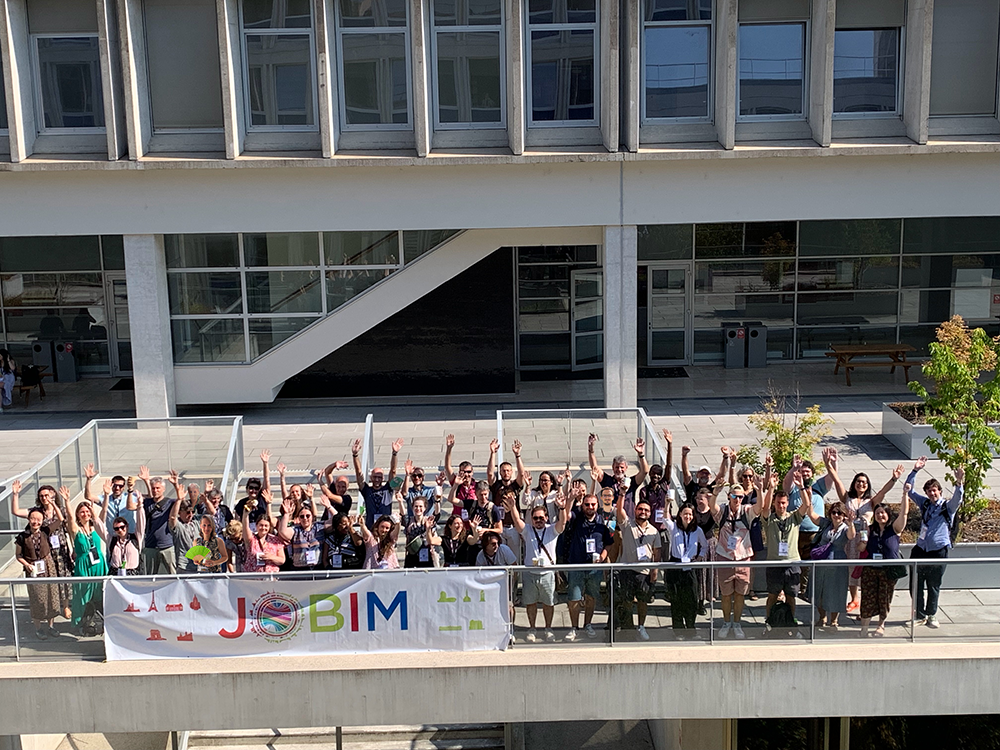
For the next edition of JOBIM, the IFB/ELIXIR-FR teams look forward to seeing you in Grenoble from 6 to 9 July 2027!