
From 22 to 26 June, a delegation from IFB/ELIXIR-FR was in Clermont-Ferrand to take part in the Galaxy Community Conference 2026 (GCC2026), the Galaxy community’s flagship international event. Co-organised by Clermont Auvergne University (UCA), the French Institute of Bioinformatics (IFB/ELIXIR-FR) and the AuBi platform, as well as Johns Hopkins University (USA), this year’s event brought together 200 researchers, engineers, developers and platform managers – with around 50 joining via video link – to discuss the Galaxy data analysis environment and the challenges of open science and big data analysis in the life sciences.
Translated with DeepL.com (free version) A three-day conference followed by two days of training and a collaborative hackathon – CoFest – to take stock of ongoing projects and launch new ones.
A full summary of the conference is available on the Galaxy project website, and videos of the presentations can be found on the dedicated YouTube channel. This year’s event was notable in particular for the numerous presentations focusing on the use of AI in the development and application of Galaxy. The report on a session dedicated to this topic is also available online.
IFB/ELIXIR-FR was represented throughout this 2026 edition by the organisers Bérénice Batut, Gildas Le Corguillé and Anthony Bretaudeau, as well as Guillaume Kermogant and Nadia Goué, and by bioinformaticians working on the IFB community’s platforms (AuBi, Pasteur Hub, Migale, ABiMS, GenOuest and InforBio). From data analysis to community dynamics, they actively contributed to the various sessions. More broadly, the French Galaxy community now encompasses ‘non-omics’ topics such as the Earth system and ecology, which are well represented by members from Data Terra, the Concarneau Museum and the BRGM.
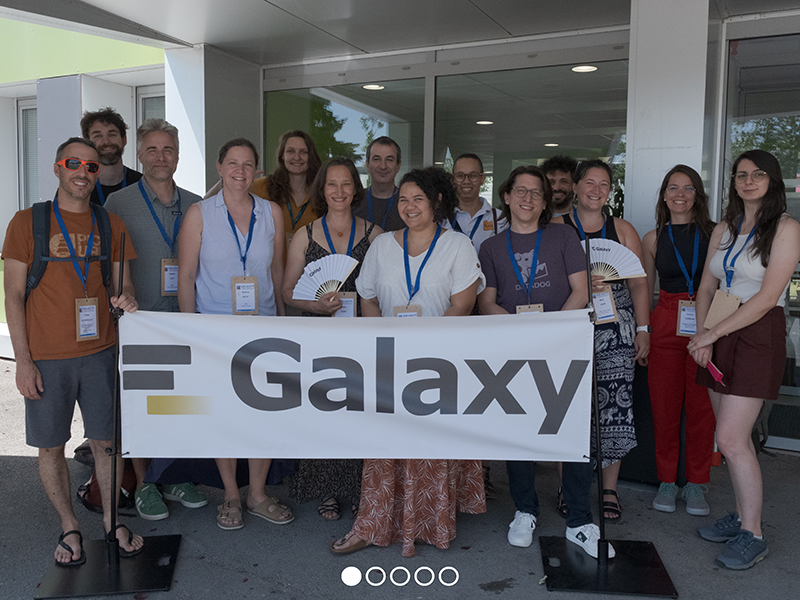
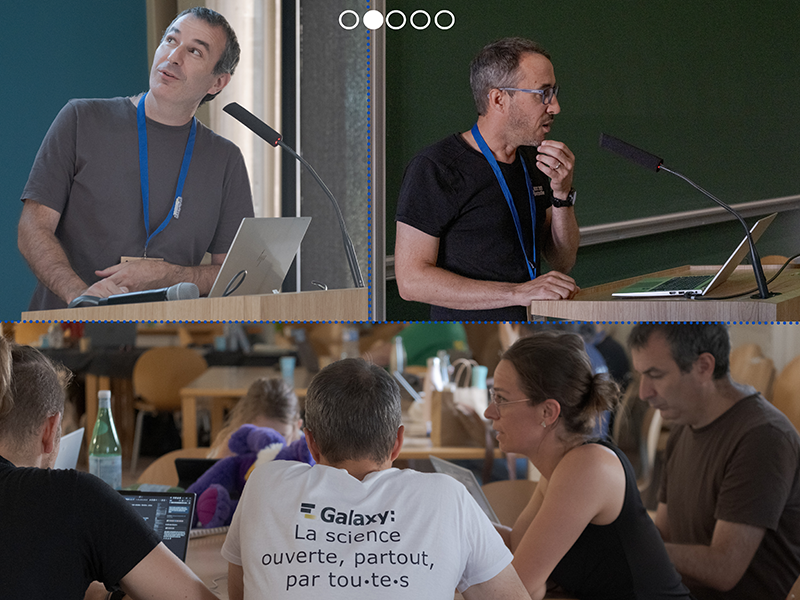
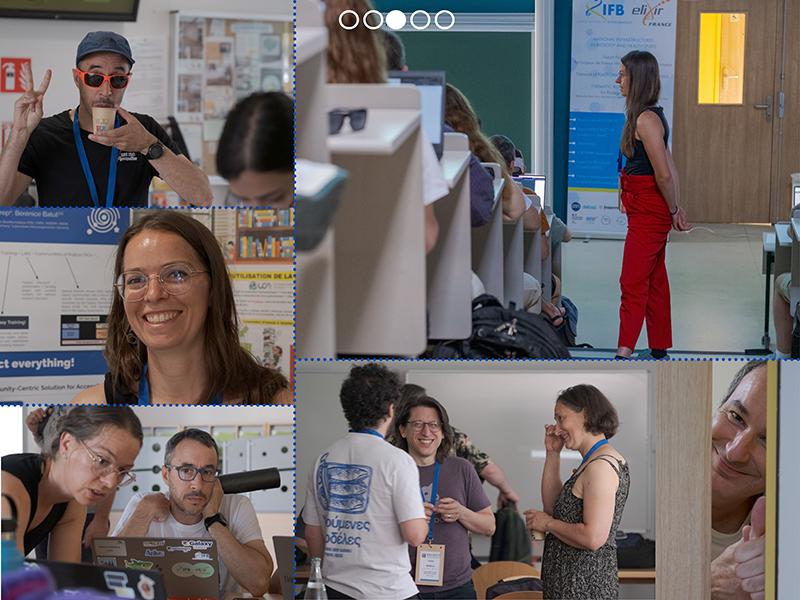
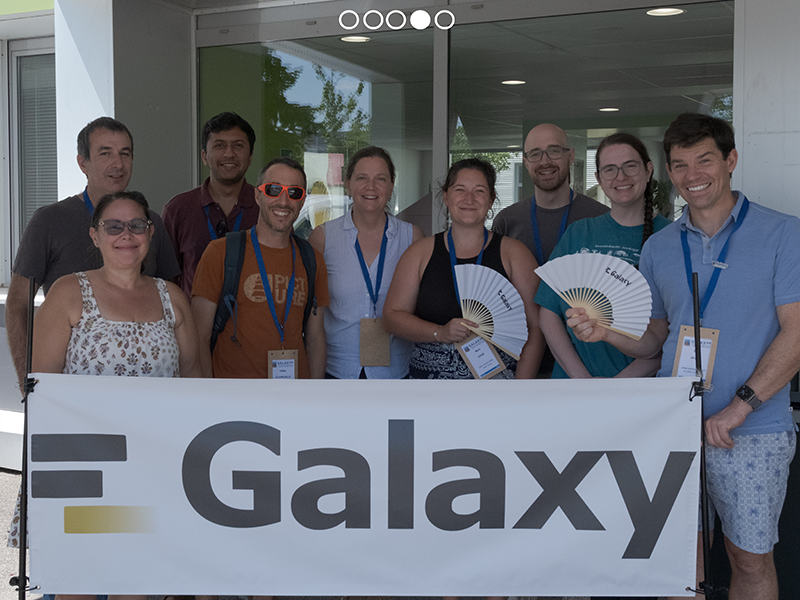
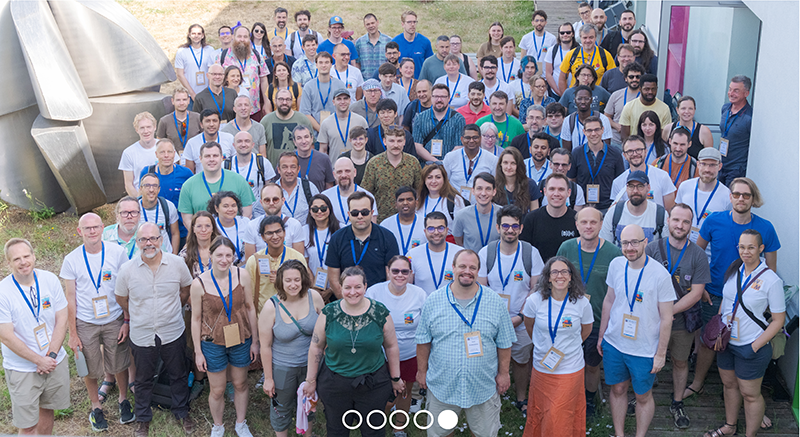
Photo credits – Bérénice Batut
Find out more about the talks and posters presented by our team at GCC 2026
As organisers, Bérénice Batut, Gildas Le Corguillé and Anthony Bretaudeau opened the conference with a presentation on the history of the French Galaxy community (https://hal.science/hal-05693116, https://f1000research.com/slides/15-1124). Anthony Bretaudeau later took part in the “Galaxy Community Update” presentation, representing the French community.
On the metagenomics and microbiome front:
- Talk and Poster: ‘FAIRyMAGs: A Modular, FAIR-Compliant Galaxy Workflow Suite for Flexible and Scalable Metagenome-Assembled Genome Reconstruction’ by Bérénice Batut (IFB/ELIXIR-FR) and Paul Zierep (https://hal.science/hal-05685741)
Bérénice Batut co-authored a presentation and a poster on FAIRyMAGs, a suite of modular workflows compliant with FAIR principles, developed within Galaxy for the reconstruction and analysis of metagenomes (MAGs), in collaboration with four ELIXIR nodes as part of the ELIXIR programme ‘Biodiversity, Food Security and Pathogens ’ (BFSP).
- Poster ‘Microbiology Galaxy Lab: The first community-driven gateway for reproducible and FAIR analysis of microbiological data‘ by Bérénice Batut (IFB/ELIXIR France), Engy Nasr, Nikos Pechlivanis, Nikolaos Strepis, Paul Zierep (https://f1000research.com/posters/15-1114, https://hal.science/hal-05693236)
Bérénice Batut is a co-author of a poster on the Microbiology Galaxy Lab (MGL), a global community platform dedicated to the reproducible and FAIR-compliant analysis of microbiological data, developed using the Galaxy framework.
Biodiversity and Biotechnology:
- Poster ‘The Biodiversity Genomics Galaxy Lab: A Collaborative Hub with curated tools, workflows and training’ by Solenne Correard, Bérénice Batut, Anthony Bretaudeau (ELIXIR-FR), ELIXIR Biodiversity Community, Waterhouse Robert M. (https://f1000research.com/posters/15-1166)
Anthony Bretaudeau and Bérénice Batut have co-authored a poster presenting the Biodiversity Galaxy Lab, a subdomain accessible to any Galaxy instance, designed to make Galaxy’s vast bioinformatics resources accessible and relevant to researchers in the field of biodiversity genomics. It offers a selection of tools, workflows and tutorials tailored to the needs of this dynamic scientific community.
In terms of tools and infrastructure:
- Poster ‘Navigating Galaxy’s Growth: How CoDex Lower Barriers to Access’ by Solenne Correard, Anthony Bretaudeau, Bérénice Batut (IFB/ELIXIR France) and Paul Zierep (https://f1000research.com/posters/15-1115, https://hal.science/hal-05693206)
Anthony Bretaudeau and Bérénice Batut have co-authored a poster presenting the Galaxy Codex, a catalogue of Galaxy resources (tools, tutorials, workflows), which the various communities can filter to find the resources they need and showcase through Galaxy Labs, which are themed Galaxy sub-domains.
- Poster ‘Galaxy-BioProd: An Integrated FAIR Platform for Synthetic Biology, Biotechnology and Life Cycle Analysis’ by Anthony Pragassam Thomas Chaussepied, Anthony Bretaudeau, Gildas Le Corguillé, Jean-Loup Faulon, Valentin Loux (https://f1000research.com/posters/15-1175 https://hal.science/hal-05694938)
Anthony Prassagam co-authored a poster with the UseGalaxy.fr team describing how the UseGalaxy.fr portal is used to support the Galaxy-BioProd project.
Finally, on the fringes of the official conference, Anthony Bretaudeau and Gildas Le Corguillé represented the French community at the traditional Galaxy Summit, the annual coordination meeting between the various international communities (funding, usegalaxy.*, organisation of upcoming GCCs, etc.).
To find out more about this event, please visit the dedicated GCC2026 website.