
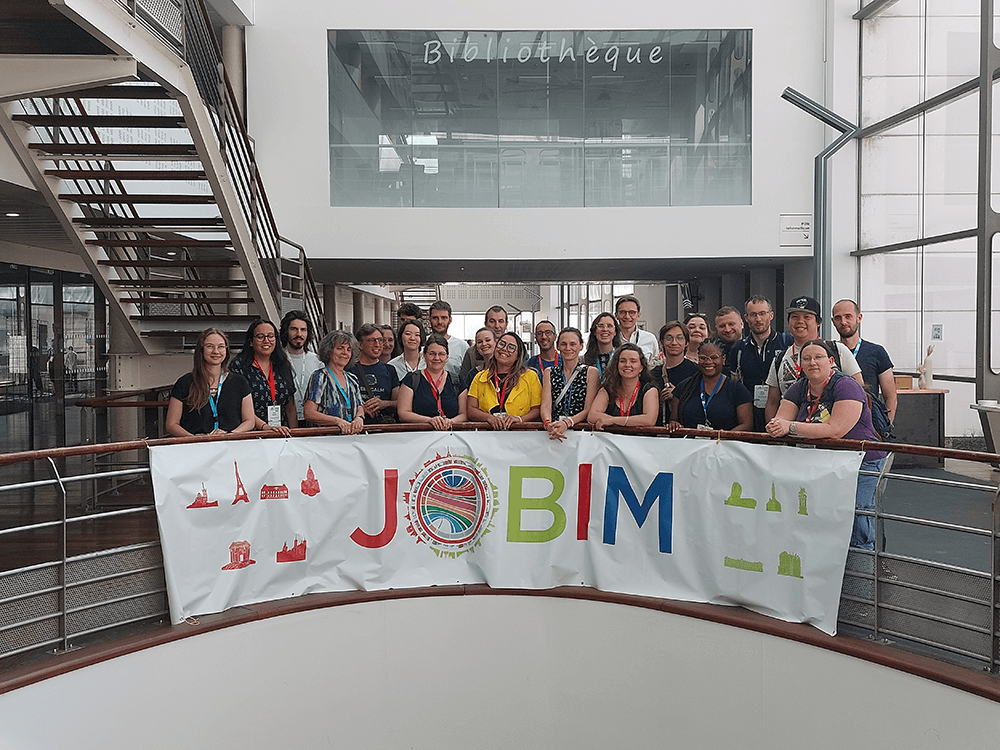
From July 8 to 11, 2025, the French Institute of Bioinformatics (IFB/ELIXIR-FR) was in Bordeaux for JOBIM 2025, a major annual event for the French-speaking bioinformatics community. Conferences, posters, demonstrations, informal discussions… A look back at a particularly rich edition for the IFB teams.
From the very first day, the IFB-core event committee took over the new IFB/ELIXIR-FR booth, set up at ENSEIRB-MATMECA in Talence alongside those of the SFBI and JeBIF. Participants were able to meet the teams there to answer their questions, and discover flyers for two of the projects led by the IFB: ABRomics, dedicated to the genomic surveillance of antibiotic resistance, and Galaxy France, the national body of the Galaxy Project platform.
A live demonstration of ABRomics, presented by Amanda Dieuaide, provided a concrete illustration of the loading of bacterial genome sequencing data, its processing by the various analysis pipelines, and finally the exploration of the results through the platform’s graphical interfaces. Future features of the platform, currently being implemented, were also presented.
In addition, a highly anticipated presentation of Madbot (#MadobotByIFB) was held to a full house. This innovative tool was developed by the IFB-core (IFB’s coordinating unit) to facilitate the management and sharing of data and associated metadata. It automates the organization, description, and submission of data to repositories such as Zenodo or ENA (European Nucleotide Archive), while respecting international standards. The result: more open and accessible data (FAIR principles) with a simplified data submission process!
Twelve posters presented by IFB-core in three days
JOBIM is also an opportunity to showcase its work. And this year again, the IFB was there with a strong representation that reflects the diversity and complementarity of our activities.
- French Bioinformatics Institute’s Initiatives for Biodiversity Genomic / Data Management – Clara EMERY, Lucas LECLÈRE, Eric PELLETIER, Vincent LEFORT, Yvan LE BRAS and Erwan CORRE
The Biodiversity Community, co-led by the IFB and the PNDB (National Biodiversity Data Hub of DATA Terra), is committed to better management of genomic data for various applications. The MUDIS4LS project places a particular focus on marine organisms and marine biodiversity research data: data management plans, best practices, and national infrastructures are at the heart of the work to make research more accessible and interoperable.
- IFB/ELIXIR-FR contributions to the ELIXIR Training Platform – Olivier SAND, Bérénice BATUT, Frédéric de LAMOTTE, Lucie KHAMVONGSA-CHARBONNIER, Hélène CHIAPELLO and Anne-Françoise ADAM-BLONDON
As part of our activities as the French node of the European ELIXIR Europe infrastructure, the IFB plays a key role in developing bioinformatics skills at European level. The poster provided an opportunity to present the projects we are involved in, such as TeSS, the Training Metrics Database, Learning Paths and SPLASH… as well as trainer training, notably through the Galaxy training network, multi-omic integration, machine learning… and the organisation of multi-node training courses on AI.
- BYTE-Sea: the digital infrastructure of ATLASea, the French marine genome sequencing program France 2030 – Annie LEBRETON, BYTE-Sea consortium and Erwan CORRE
The ATLASea research programme aims to sequence the genomes of 4,500 marine eukaryotic species, representing around one third of the known marine species in mainland France and its overseas territories. The data collected is stored in BYTEsea, an open-access database for the scientific community. The BYTEsea project, led by the IFB, ensures the interoperability and security of the ATLASea programme’s data, and facilitates its dissemination and use in accordance with the FAIR and Open Science principles.
- Breaking Myths: The Reality of Galaxy’s Capabilities and Impact – Gildas LE CORGUILLE, Anthony BRETAUDEAU, Björn GRUENING, GT Galaxy, and Bérénice BATUT
Founded in 2005, Galaxy supports diverse scientific fields and has been widely adopted in France, with more than 10 servers and UseGalaxy.fr as its national authority. But Galaxy is not just an analysis tool adapted to genomics! A key player in open science computing, it offers more than 3,000 tools for diverse fields such as metabolomics, machine learning, and ecology. Supported by the IFB and ELIXIR, with an active community, UseGalaxy.fr supports large-scale projects and facilitates complex analyses, while ensuring an intuitive user experience and workflows compliant with FAIR principles.
For more details, see the dedicated article on Galaxy Project .
- Galaxy Training: A powerful framework for teaching! – Helena RASCHE, Saskia HILTEMANN, Björn GRUENING, Galaxy Training Network, Bérénice BATUT
Technological advances have increased the need for computer skills in the life sciences, but many researchers unfortunately lack adequate training in data management and analysis. To address this gap, the Galaxy Training Network has created an open FAIR training platform based on the Galaxy tool. The Galaxy Training Platform offers more than 450 tutorials, 135 hours of videos, and mobilizes more than 450 contributors from the Galaxy community. The platform has also become a key tool for teachers and now offers dedicated resources for training the trainers.
- Exploring the Richness of the French Galaxy Ecosystem – Bérénice BATUT, GT Galaxy, Gildas LE CORGUILLE, Anthony BRETAUDEAU
The poster presented UseGalaxy.fr, the French instance of the Galaxy platform supported by the French Institute of Bioinformatics (IFB), which plays a key role in the advancement of bioinformatics in France. Thanks to a powerful computing infrastructure, more than 3,000 tools, and a committed community, it facilitates data analysis for thousands of users. Come discover our presentation of the Galaxy ecosystem in France, its concrete use cases, and its integration into scientific projects of national and European scope.
- Data modeling in agroecology, a first schema to characterize plant holobiont and environmental data – Alice MATAIGNE, Marie LAHAYE, Fabrice LEGEAI, Olivier DAMERON, Olivier RUE and Valentin LOUX
Developed as part of the DeepImpact project, a new RDF data model is being developed to describe plant holobionts and environmental data. This interoperable model can also be used for projects describing only microbiota or environmental data, thus promoting the reproducibility of analyses. This project will then be integrated into an information system to facilitate data collection, storage, and access.
- ABRomics-analysis: Developing Metagenomic Workflows for National Antibiotic Resistance Surveillance Platform – Hugo LEFEUVRE, Audrey BIHOUÉE, Bérénice BATUT, Claudine MEDIGUE, Philippe GLASER and Samuel CHAFFRON; A multi-modal and temporal antibiotic resistance knowledge graph – Brieuc QUEMENEUR, Audrey BIHOUEE, Samuel CHAFFRON, Claudine MEDIGUE, Hervé MENAGER, Alban GAIGNARD.
The ABRomics digital platform dedicated to genomic surveillance and research on antibiotic resistance, whose development is supported by the IFB and the Pasteur Institute, presented two dedicated posters.
The first poster presented the future Galaxy metagenomic workflows used by ABRomics, and presented the three proposed pipelines, which will make it possible to characterize antibiotic resistance without going through bacterial isolation, by relying directly on environmental, animal or human samples.
The second poster presented the knowledge graph used by ABRomics to ensure the structuring of the platform’s data and its interoperability. This graph incorporates temporal and geographical dimensions, in accordance with the FAIR principles (findable, accessible, interoperable and reusable).
- Annotating Bioconductor packages using the EDAM ontology – Claire RIOUALEN, Maria DOYLE, Alban GAIGNARD, Vincent CAREY, Hervé MENAGER
EDAM is an ontology that standardises terminology for data analysis in the life sciences. The open-science Bioconductor project, which offers over 2,000 packages for a wide range of bioinformatics applications, uses biocViews, an in-house vocabulary that is, however, limited in terms of its interoperability. The aim of this project is to annotate Bioconductor packages with EDAM in order to automatically integrate them into the ELIXIR ecosystem, thereby improving the visibility and interoperability of the packages. Scripts and methods based on large language models (LLMs) facilitate this transition, enhancing the FAIRification of resources and the links between Bioconductor and ELIXIR.
All of these presentations and posters are published and can be found in their entirety in the IFB-core HAL collection .