
Invited to the Pasteur Institute on 1 April 2026 for a seminar, the madbot project team presented our new tool—which addresses the challenges of managing, sharing and submitting biological data—to an audience of around fifty people. The meeting also provided an opportunity to discuss the tool’s prospects and future developments, and to agree on common objectives for future collaboration.
A tool for making ever-increasing amounts of data FAIR
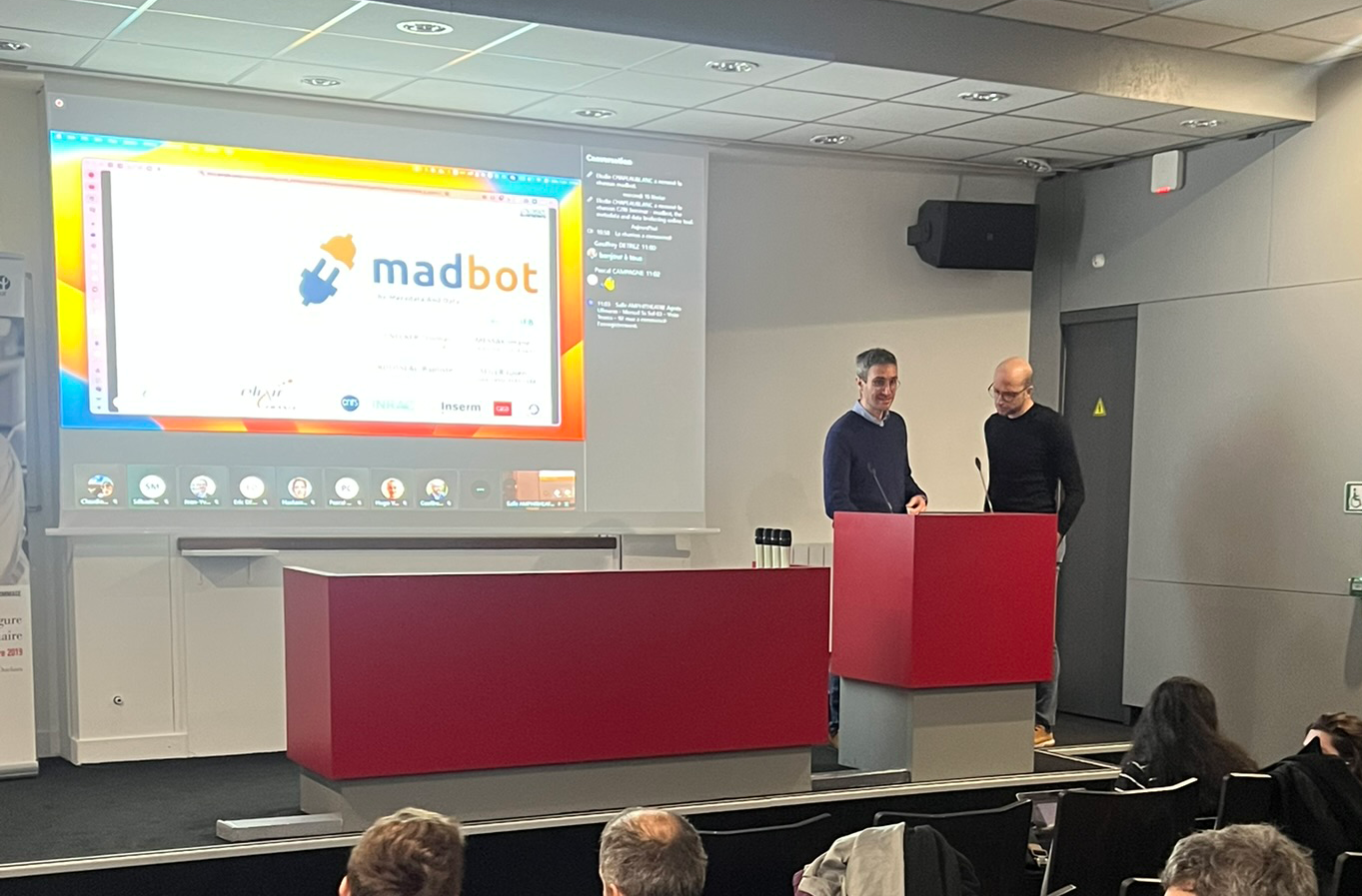
In their introduction to this seminar, Thomas Denecker and Julien Seiler, the project’s co-leaders, highlighted the current landscape characterised by big data, a trend from which biology is no exception (6.5 billion sequences and 44.8 trillion bases recorded in the European Nucleotide Archive as of 16 March 2026).
In this context, madbot offers researchers a tool for:
- Centralise, annotate and organise their data and metadata;
- Work effectively as part of a team;
- Submit their datasets to major public repositories.
This approach therefore helps to move towards data that is more FAIR (Findable, Accessible, Interoperable, Reusable), one of the cornerstones of more open science.
“madbot was born out of a simple observation: researchers spend too much time managing their data and metadata. Our aim is to free up their time so they can focus on analysing that data.” – the project team.
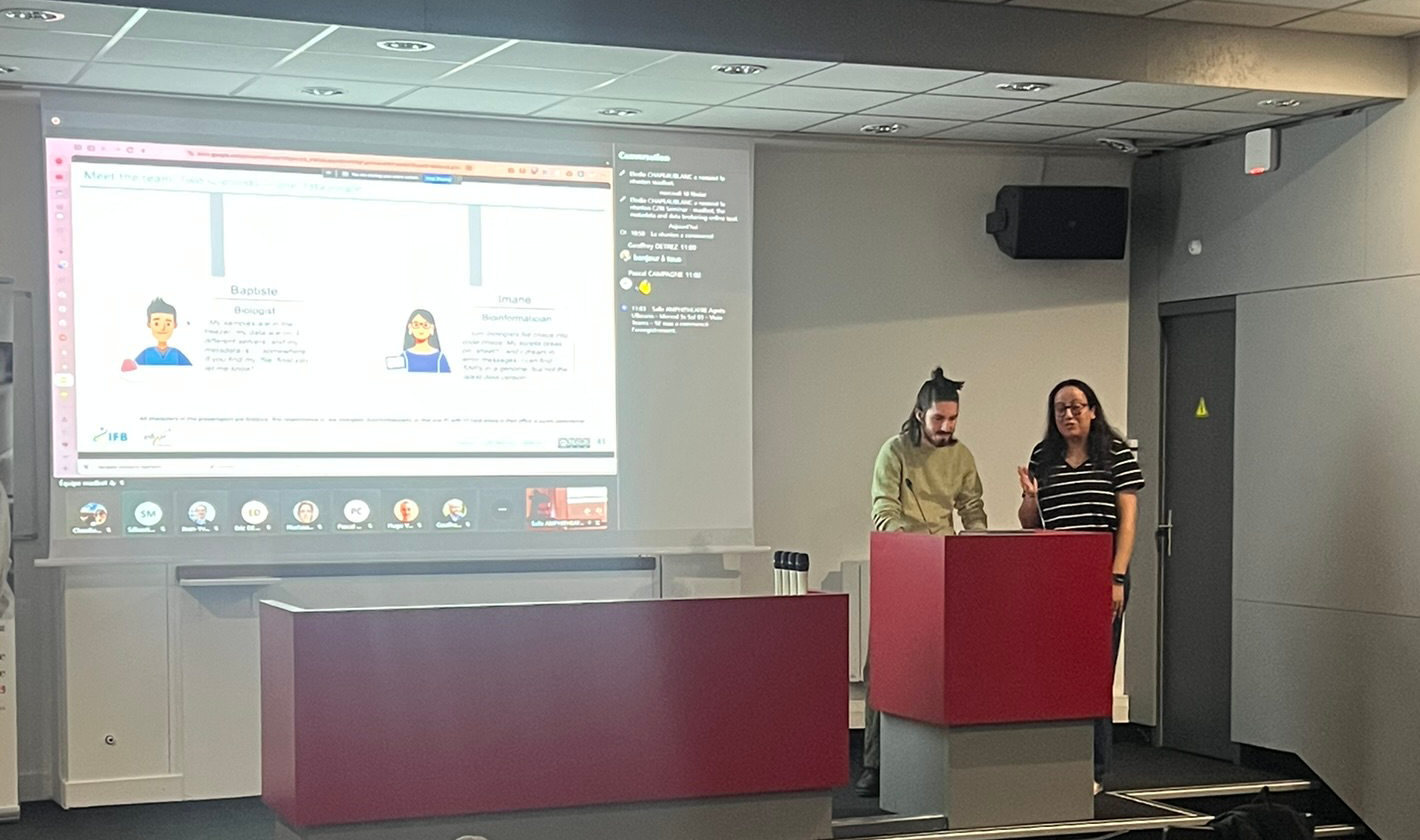
To provide a clearer understanding, Imane Messak and Baptiste Rousseau, developers and bioinformaticians on the madbotByIFB team, gave the audience a demonstration of the tool. To make it more realistic, they took on the roles of two biologists using madbot who were grappling with this data management issue. It was a successful demo!
Madbot in few figures
Since its launch in December 2025, madbot already has 80 users and 59 active workspaces, 735 datalinks, 1,340 metadata entries and 51 GB of submitted data. The tool, designed to be modular and scalable, enables and will continue to enable the scientific community to contribute via plugins tailored to their specific needs.
For more information, see the presentation on HAL and on the madbot By IFB website.