
IFB/ELIXIR-FR offers services to support the biology and health research community in making their data FAIR (Findable, Accessible, Interoperable, Reusable). We also contribute to national initiatives within the Research Data Gov ecosystem and the Committee for Open Science (CoSO) via the Research Data College, as well as to open science projects led by INRAE and CNRS.
Data
Research data
IFB/ELIXIR-FR is part of the National Plan for Open Science, offering services in two areas:
- Data: Structuring, sharing and opening up research data
- Software: Opening up and promoting source codes produced by research
You can also view our Open Science R&D projects on the dedicated page.
With regard to open access to publications, our work is freely available via our HAL collection.
The data lifecycle
- What are research data, the challenges associated with their rational management, and the benefits of their dissemination? : Guide for researchers
- What is the data lifecycle? Poster produced by INRAE
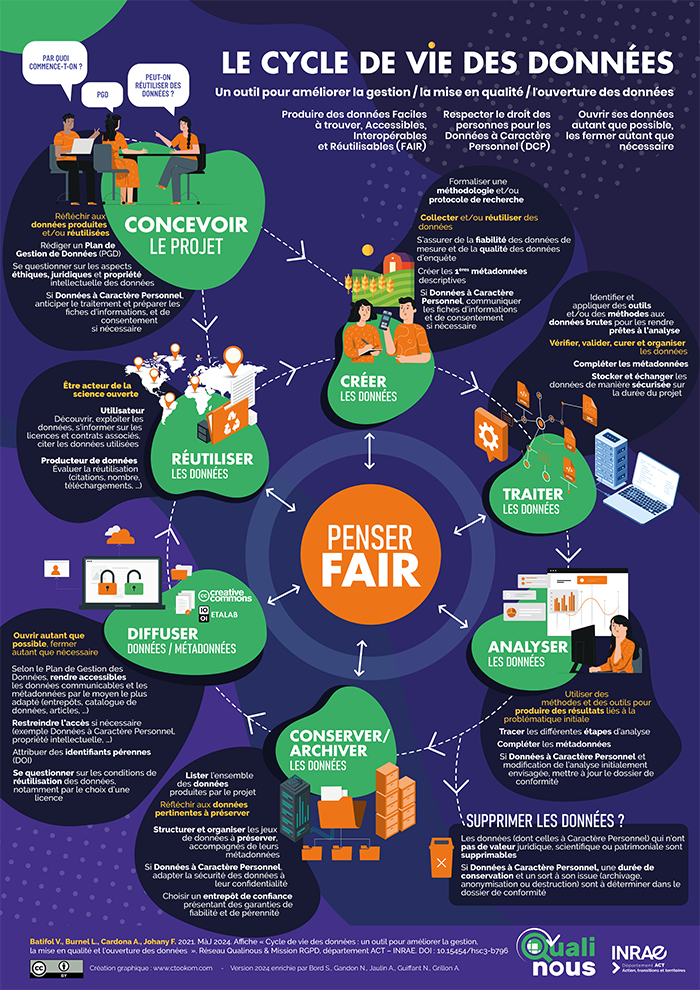
Members of IFB/ELIXIR-FR have also contributed to the drafting of practical guides on the subject:
Trainings
We regularly offer FAIR DATA training courses to teach participants how to manage data in accordance with FAIR principles. Training materials are available on our Moodle Training website.
IFB resources and tools for open science
Developed by our platforms
- They are included in the IFB’s catalogue of services.
- The URGI platform offers services for the FAIR management of data on plants of interest to agriculture and forestry. Find out more
Developed and/or operated by IFB-core
MadBot – metadata management and data submission to warehouses
Maturity: finalized
Version: V1
Madbot is a tool designed to help researchers manage and share their scientific data more easily. With the constant increase in the volume of research data, it is becoming increasingly difficult to ensure its accessibility, reusability and comprehensibility. Although other tools exist to facilitate certain steps in this process, they often lack automation, standardisation or flexibility. Madbot solves these problems by offering a simple and comprehensive solution that complies with international data standards, thereby simplifying the publication of researchers’ work. It automates much of the work involved in organising and describing data, saving researchers considerable time and energy. Madbot also helps to ensure that data is described correctly and consistently, in accordance with established standards. This makes it easier to search for and use data at a later stage. The tool connects to various international platforms such as Zenodo and ENA (European Nucleotide Archive), allowing researchers to easily submit their data directly to these repositories. Madbot’s intuitive interface allows users to interact with the system even without technical expertise. Behind the scenes, the tool ensures optimal organisation, automatically checks for errors and helps researchers create accurate, high-quality metadata. Madbot’s architecture is designed to be easily extensible, allowing for integration with various data storage solutions, data warehouses and metadata standards. This flexibility allows researchers to tailor the tool to their specific needs, ensuring seamless interoperability with different research infrastructures. By simplifying the research data submission process, Madbot encourages researchers to adopt open science principles, making their work more accessible. Ultimately, Madbot helps reduce barriers to research data sharing and facilitates scientists’ contributions to the international scientific community.
FairChecker – assessment of compliance with FAIR principles
Maturity: finalized
FAIR-Checker, software developed by the French Institute of Bioinformatics (IFB), is an online tool facilitating the evaluation of FAIR (Findable, Accessible, Interoperable, Reusable) principles, the reporting of indicators and the improvement of metadata quality for web resources in life sciences. With a European reach, since it has been labeled SDP ELIXIR, FAIR-Checker is now widely used, with an average of 115,000 FAIR metric evaluations carried out each month in 2024.
Data Stewardship Wizard (DSW) – data management plan (DMP) and entity plan for platforms
Maturity: finalized
DSW, developed via ELIXIR Europe, is an online system dedicated to data management plans (DMPs). At its level, IFB maintains a Data Stewardship Wizard service and is involved in its translation into French, in order to meet the needs of various national partner infrastructures in biology and health. IFB supports these structures in designing their thematic data management plans and thus defining the strategies for their various platforms. The aim is to ultimately enable all their users to benefit from machine-actionable DMPs, in order to facilitate the work of both the scientists in charge of the data and the platform administrators.
The IFB instance is mainly dedicated to the collaborative development of thematic data management plan templates, in collaboration with national partner infrastructures (FBI, France Génomique, ProFI, MetaboHUB, ChemBioFrance, etc.). Various thematic models are available: bioimaging, genomics, proteomics, metabolomics and cytometry. These templates are used by many platforms to develop their entity data management plans.
Work on interoperability with DMP-OPIDOR is underway, so that models and PGDs completed on DSW can be made available on the tool developed by INIST.
Developed by other bioinformatics organisations in France
They are available on Bio.Tools and integrated into the IFB’s catalogue of services.
Software
Software and source codes
Available at GitLab and GitHub at IFB/ELIXIR-FR
Trainings
We regularly offer FAIR-BIOINFO and WF4Bioinfo training courses on implementing FAIR principles in bioinformatics/biostatistics analysis projects and workflow and software tool development. Training materials are available on our Moodle Training website.
Guide
ELIXIR proposes best practices to ensure that bioinformatics software and workflows are developed in accordance with FAIR principles.
Focus on a guide
What are software and codes, and why does opening them up help to make research results reproducible?