
Research data must be easy to find, accessible, interoperable and reusable (FAIR). The Recherche Data Gouv ecosystem is dedicated to managing, sharing and opening up French research data in order to meet these principles. Recherche Data Gouv is part of the second National Plan for Open Science and provides access to the National Research Data Platform:
- a web portal for searching, discovering and reporting datasets (entry point to the ecosystem).
- A multidisciplinary repository for hosting research datasets.
- A catalogue (coming soon).
- A federation of competence centres and platforms that support researchers/institutions on issues related to data management, metadata, licences, etc.
Within thi ecosystem, IFB as been chosen as Centre de référence thématique (CRT – Thematic Reference Center) covering the field of Biology and Health.
Concerned Thematics : All thematics domains from fondamental biology to its applications domains (notamment microbiology, health, agriculture et food, biodiversity, environment)
Data concerned: All types of biological data and associated data, particularly in the above-mentioned subject areas.
Types of data processed: Various types of data, predominantly big data from high-throughput technologies, including sequencing, proteomics, metabolomics and imaging. Codes associated with software development and analysis workflows.
Recherche Data Gouv is a national ecosystem designed to support the scientific community in the ethical management of their research data. The opening up of research data is strongly encouraged within the framework of the national plan for open science (PNSO). As such, IFB participates in all of the ecosystem’s actions and initiatives, particularly in interaction with regional data workshops.

Our missions within Recherche Data Gouv
As a CRT, IFB contributes to the definition and adoption of standards for data description and dissemination in the field of biology and health.
The activities of IFB/ELIXIR-FR as a Thematic Reference Centre for Biology and Health data are divided into five areas:
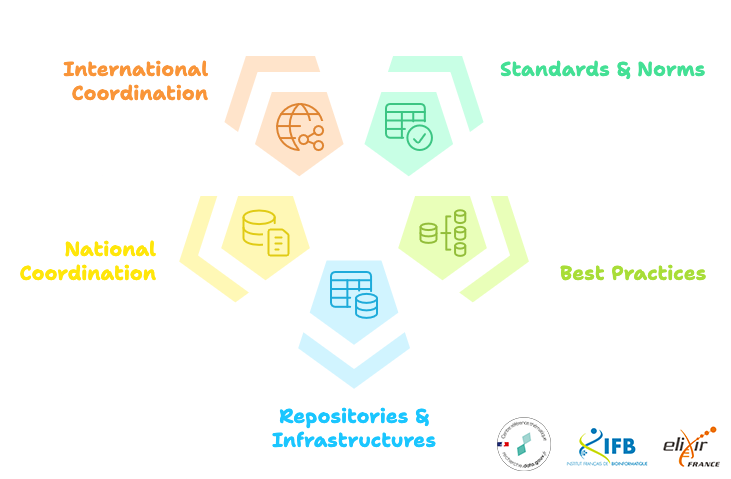
1. Norms and standards
Objective: to guarantee the quality, consistency and interoperability of research data in biology and health.
Related actions:
- Define standards for metadata, controlled vocabularies, ontologies, and recommended formats.
- Disseminate best practices for data description.
- Contribute to international harmonisation (alignment with international standards).
The IFB contributes to developing metadata standards for different types of data and subject areas in biology. In order to take into account the diversity of biology fields, the IFB collaborates with other French National Infrastructures for Biology and Health (INBS) and with other nodes in the European ELIXIR network.
The IFB supports the development and adoption of ontologies defining the terms used in a community or field of biology and health. In particular, the IFB/ELIXIR-FR contributes to the EDAM ontology, which defines the types and formats of biological data.
2. Production and dissemination of best practices
Objective: to support researchers and data-generating platforms throughout the data lifecycle.
Actions:
- Define and document best management practices, from collection to long-term preservation.
- Draft and distribute guides, protocols, and templates for data management plans (DMPs) tailored to the discipline.
- Train and raise awareness among scientific communities about FAIR practices.
IFB/ELIXIR-FR contributes to defining and disseminating best practices for managing data and software code produced in biology and health projects, drawing in particular on RDMkit, the knowledge and resource portal for data management developed by ELIXIR.
IFB deploys and maintains Data Stewardship Wizard (DSW@IFB), a service that offers to develop PGDs based on templates, and develops templates in collaboration with other French INBSs.
IFB develops other software tools and offers training courses to support researchers in FAIR practices.
3. Depots & infrastructure
Objective: to guide researchers towards reliable repositories based on their data types in the field of biology and health.
Actions:
- Identify relevant national and international depots.
- Recommend or label certain disciplinary warehouses as trusted storage facilities.
- Ensure the harvesting of metadata from these warehouses to enrich the Recherche Data Gouv catalogue.
The IFB defines the list of reference data warehouses in the various thematic areas of biology and health. This is done in collaboration with national networks (in particular the INBS specialising in different types of data) and international networks (in particular the European ELIXIR infrastructure).
4. National structuring
Objective: to integrate the field of biology and health into Recherche Data Gouv
Actions:
- Contribute to the thematic tree structure of health biology data in the Recherche Data Gouv repository.
- Linking specialised biology and health initiatives with the national Recherche Data Gouv platform.
- Represent the scientific community before the MESR and the Recherche Data Gouv Steering Committee.
The IFB supports coordination between specialised thematic initiatives and Recherche Data Gouv by participating in national events and cross-disciplinary working groups. The IFB participates in the Recherche Data Gouv members’ council, one of the governing boards.
5. International structuring
Objective: to position French research within European and global open data networks.
Actions:
- Participate in the co-construction of international standards.
- Promote cross-border interoperability of data sets.
- Represent France in international infrastructure governance bodies.
As the French node of ESFRI ELIXIR, IFB/ELIXIR-FR contributes to the pooling of resources involved in all stages of biological data management. In particular, it is involved in projects related to data management (ELIXIR-CONVERGE) and the development of federated infrastructures (GDI). ELIXIR-FR promotes specialised knowledge bases in various fields of biology (including Global Data Alliance) and participates in their international certification (ELIXIR core data resources). ELIXIR-FR is also involved in drafting an ELIXIR Position Paper on securing open resources for biological data.
Background to our role as CRT
During the renewal of the 2021 national roadmap for research infrastructures, the practices, tools and skills for managing the entire data lifecycle in candidate infrastructures were assessed. Some scientific fields have specialised one or more of their infrastructures in data management and dissemination for their scientific community. These infrastructures are part of an international ecosystem and contribute to the definition and adoption of standards for the description and dissemination of data in their field. As such, these infrastructures constitute the first Thematic Reference Centres (TRCs) covering part of their scientific fields, including IFB/ELIXIR-FR for biology and health data.
As a thematic reference centre, IFB must engage communities in life sciences and health to define best practice standards for data management. This requires the involvement of a wide range of stakeholders, representative of the great diversity of data in this field. In this context, a research data group has been created and is working within the National Biology and Health Infrastructure Club (INBS).
The various initiatives to develop tools and services at the IFB, in open science, will ultimately consolidate the recommendations proposed by the reference centre.