Under the supervision of the CNRS, INRAE, CEA and Inserm, the French Institute of Bioinformatics (IFB) is both the French node of ELIXIR-FR and a national Biology-Health infrastructure (INBS). The IFB’s activities are coordinated by the IFB-Core Support and Research Unit (UAR CNRS 3601). It offers bioinformatics services (computing and storage, software development and deployment, knowledge bases, data management, project support), organizes training and participates in methodological innovation in this field of research. It brings together 21 member platforms, 7 contributing platforms and 8 associated teams which cover all areas of bioinformatics and all thematic areas of fundamental biology and its applications (health, environment, agronomy).
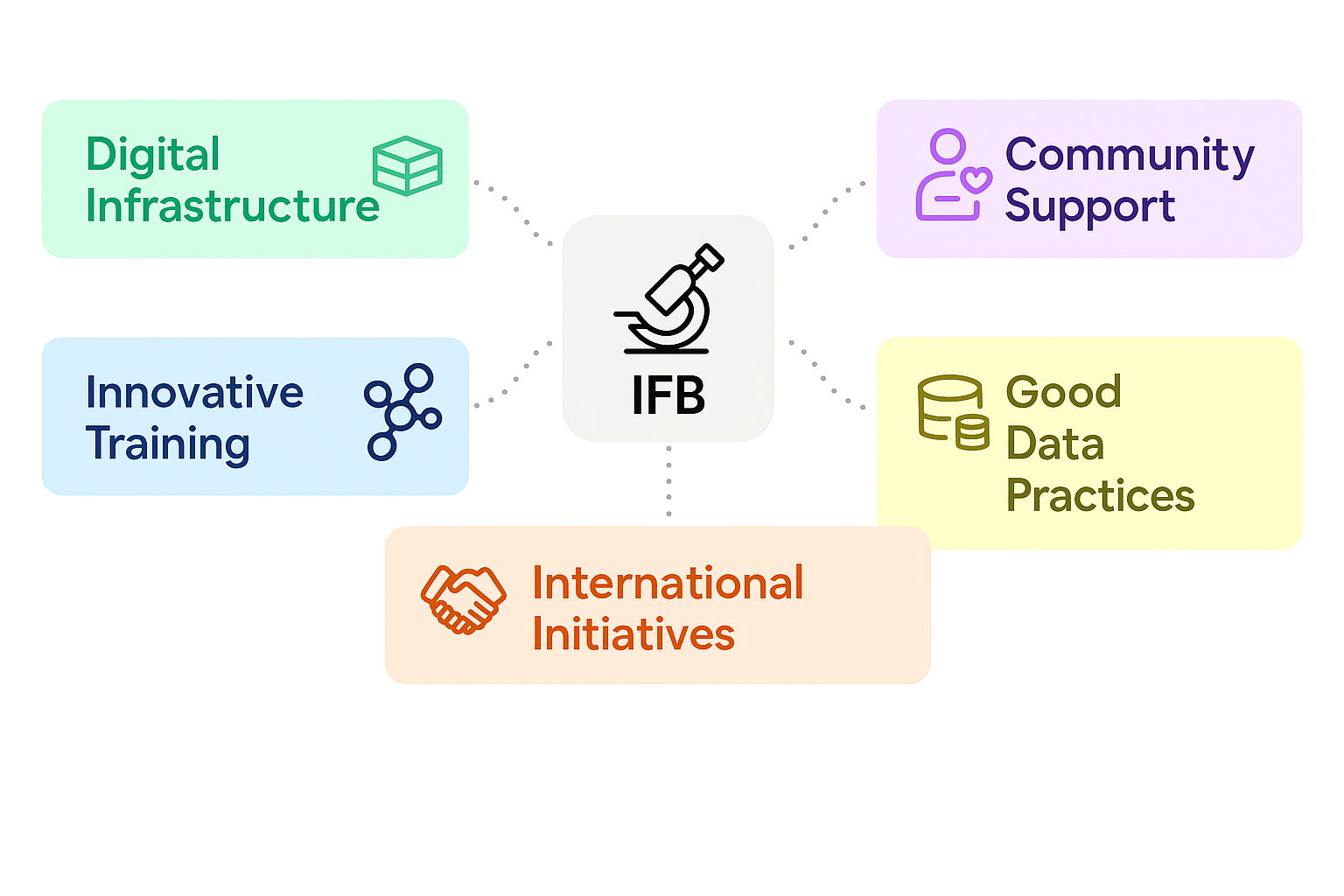
The IFB's missions
- Deploy a digital infrastructure adapted to the needs of biology-health research
The IFB provides computing equipment, storage and software environments via a decentralized national infrastructure (the NNCR – National Network of Computing Resources), managed by the coordinating unit.
- Supporting communities of biologists in the management, processing and analysis of their data
The IFB offers a set of services supported by the network’s platforms as well as user support to promote the exploitation of omics, imaging and structural data, at each stage of their life cycle.
- Promote good practices in data and code management
The IFB’s developments are part of an open science approach in accordance with the FAIR principles (Findable, Accessible, Interoperable, Reusable), ensuring the quality, traceability and reusability of scientific data.
- Develop innovative training actions
The IFB offers training at various educational levels at the local, national, and European levels. The IFB organizes around thirty training courses per year, reaching approximately 2,000 trainees. The IFB also contributes to Galaxy Europe’s online training courses, which attract thousands of trainees worldwide. It contributes to the technical support of ELIXIR’s Training Metrix Database, the curation of TeSS, its training catalog, and numerous activities on its “Training” platform.
- Articulate national activities with international initiatives and infrastructures
The IFB is part of a European and international dynamic through its active participation in networks such as ELIXIR (French node), the RDA (Research Data Alliance) and the EOSC (European Open Science Cloud).
The IFB stands out from other INBS (National Institutes of Biology and Health) by its transversal and technological nature. It is not specialized in a specific field of application or societal themes. It is aimed at the bioinformatics community as well as the various life sciences communities including the environment, and covers large-scale data processing (structural biology, proteomics, sequencing, metabolic, imaging, etc.) on living systems, interfacing with many other INBS.
The IFB is based on a federated model articulated around the UAR IFB-core coordinating unit and a national network of platforms that directly provide a large part of the IFB’s services. Operations are structured by a supervisory committee, a scientific council, and an action coordination committee (CoCoA), ensuring strategic coherence and responsiveness. Scientific actions are organized into cross-cutting actions and thematic communities.
This model makes it possible to orchestrate large-scale national projects, pool human and technological resources, and ensure a strong link with national (open science, FAIR data) and European (ELIXIR) policies. The UAR structure, managed by the CNRS, facilitates multi-site management and the integration of partner platforms.
IFB Governance
The IFB is led by a management team structured around a director, a secretary general, and two deputy directors responsible for scientific coordination, international relations, and the national platform network. This team meets weekly to ensure the operational and strategic continuity of the infrastructure’s activities.
Governance also relies on several consultative and decision-making bodies, thus guaranteeing strategic coherence and responsiveness:
- The Supervisory Committee is composed of representatives of the partner organizations: CNRS-INRAE-INSERM-CEA. It defines the scientific, technical and administrative orientations of the infrastructure.
- The Scientific Advisory Board (SAB) brings together five French and international bioinformatics experts to support management in developing its scientific strategy. It also provides advice and recommendations on major strategic and scientific directions, and technological options for the infrastructure. The members of the IFB SAB for the period 2024-2026 are Aedin Culhane (University of Limerick, Ireland), Denis Milan (INRAE, France), Aitana Neves (Swiss Institute of Bioinformatics, Switzerland), Silvio Tosatto (Università degli Studi di Padova, Italy), and Celia van Gelder (Health-Research Infrastructure – Health-RI, the Netherlands).
- The Inter-Platform Committee (CIPI) brings together the managers of IFB member platforms to ensure consistency and harmonisation of actions at national level.
- The Action Coordination Committee (CoCoA) manages and implements the scientific program (R&D and Services), supported by the IFB-core.
Two additional committees, dedicated to ethics and data, are being studied in conjunction with other national infrastructures and the competent bodies of the supervisory organizations, in order to supervise the strategic, regulatory, ethical and societal issues linked to data in biology-health.
The IFB, a health biology infrastructure
National infrastructures in biology and health (INBS) bring together local or broader scientific and technological communities in clearly identified research areas. Organized around IBiSA-certified platforms, their objective is to provide high-level services to researchers and manufacturers, to lead and train scientific communities, and to develop innovative technological research in these areas.
The IFB, thematic reference center for Biology-Health data
To learn more about the IFB’s missions as a thematic reference center, visit our dedicated page.
To learn more about our open science development activities.